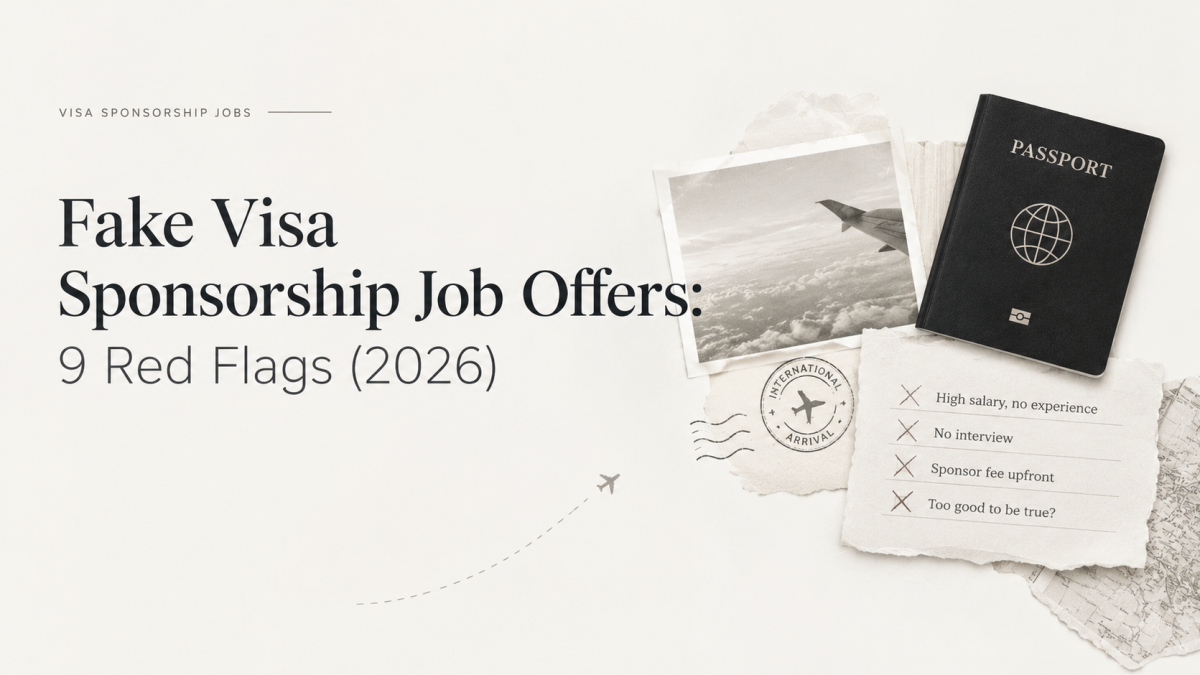
Fake Visa Sponsorship Job Offers: 9 Red Flags (2026)
A fake visa sponsorship job looks a lot more convincing in 2026 than it did a few years ago: polished websites, believable offer letters, even video interviews. The problem has grown serious enough that the UK government expanded its “Visa Fraud Se Bache” awareness campaign in India in February 2026, warning about bogus promises of guaranteed UK jobs and visas and about excessive fees, according to inkl’s report on how applicants can spot sponsorship scams. The same report notes enforcement action involving overseas workers who were charged thousands of pounds for employment and visa services that were never delivered.
If you’re applying from Nigeria, South Africa, the Philippines, India, or anywhere else, these nine red flags of a fake visa sponsorship job — each backed by a published source — are the quickest way to protect your money and your documents.
Red Flag 1: A Fake Visa Sponsorship Job Asks You to Pay
This is the clearest signal of all, and the one most likely to expose a fake visa sponsorship job early. According to inkl’s report, in a genuine recruitment process recruiters are generally paid by employers, not candidates. JobsRivo’s 2026 checklist adds that in the UK, Canada, Australia, Germany, the EU, and the Gulf states, the employer typically pays the sponsor licence and the sponsorship paperwork, and in most cases the visa fee itself — so a request for “visa processing fees” from the candidate is a scam marker. Fee arrangements do vary by country and visa type, so always ask in writing exactly who pays what before you agree to anything. F1Jobs makes the same point for the US: any request for a “deposit,” “training fee,” or “immigration advance” before a petition is filed is a scam, whatever it’s called.
Red Flag 2: “Guaranteed” Sponsorship or Approval
Every fake visa sponsorship job leans on this promise, because it’s the hook that makes people stop asking questions. Sponsorship depends on the employer, the role, your eligibility, and the destination country’s rules — there is no legitimate shortcut that guarantees it, according to inkl’s report. Be especially wary of impossible pricing: JobsRivo points out that any “USA work visa for $1,000” message is a scam, since an H-1B alone costs an employer thousands of dollars.
Red Flag 3: The Offer Letter Has No Official Reference Number
Real offers carry real paperwork references. Per JobsRivo, a genuine UK offer carries a Certificate of Sponsorship (CoS) reference, a Canadian offer carries an LMIA file number, and an Australian offer references a nominated SID. For the US, F1Jobs notes that until you hold an I-797 receipt notice from USCIS, no H-1B petition actually exists — so a signed offer letter alone doesn’t prove anything has been filed. Asking the recruiter for the reference number is one of the fastest ways to test whether a suspected fake visa sponsorship job is real.
Red Flag 4: A Fake Visa Sponsorship Job Can’t Be Verified on Official Registers
Check before you trust. For UK roles, GuardLine’s guide explains that an employer not on the official register of licensed sponsors cannot legally sponsor your visa — you can search the government’s register of licensed sponsors yourself. For the US, the USCIS H-1B Employer Data Hub shows petition history by employer. F1Jobs flags small staffing companies with fewer than five prior petitions and no verifiable clients as a warning sign. Our guide to companies that sponsor visas walks through how to read this data. If a recruiter can’t point you to any of this evidence, treat the offer as a fake visa sponsorship job until proven otherwise.
Red Flag 5: Communication Only Through WhatsApp or Free Email
JobsRivo lists communication only via WhatsApp or Gmail as a red flag, since real recruiters use a corporate email domain — a pattern worth treating as a warning sign of a fake visa sponsorship job. Profession Visa’s 2026 guide cites the USCIS March 2026 alert’s advice to hover over the “From” field and check the actual sender address rather than the display name, and adds that scam operations often rely on virtual addresses or P.O. boxes instead of a real office.
Red Flag 6: A Fake Visa Sponsorship Job Isn’t on the Official Careers Page
Scammers borrow real company names. GitLab published a warning in December 2025 about scammers impersonating its recruiters through email, LinkedIn, and video platforms, using fake domains and requesting upfront “equipment” payments after staged interviews. GitLab’s notice gives the simplest test: if the listing isn’t on the company’s official careers page, don’t proceed — a quick check that can expose a fake visa sponsorship job borrowing a real brand name. JobScamScore adds that identical text appearing across 10 or more job boards on the same day often signals a mass-distributed scam campaign.
Red Flag 7: Pressure to Decide Immediately
Artificial urgency is built to stop you from checking, and it shows up in almost every fake visa sponsorship job pitch. F1Jobs lists a recruiter pushing you to sign immediately before “visa slots run out” as a scam marker, and Profession Visa lists pressure to pay immediately as one of its top red flags. A genuine employer can wait while you verify the details.
Red Flag 8: A Fake Visa Sponsorship Job Interview Feels “Off” — Deepfakes and Voice Cloning
This is the newest tactic. Profession Visa reports 2026 cases of AI voice cloning used to mimic government officials, with caller ID spoofed to look official while demanding “emergency fees.” JobScamScore describes deepfake video impersonation of recruiters, with signs including lip-sync delays, unnatural facial movements, an AI-looking background, and an inability to answer specific follow-up questions about the company. Real recruiters, per the same guide, usually have long LinkedIn histories with authentic connections at the same company. If anything about a video call feels off, pause the process and verify the recruiter through the company’s official channels, however convincing a fake visa sponsorship job interview may seem.
Red Flag 9: A “Recruitment Agency” With No Real Presence
Fake agencies are often the first point of contact for a fake visa sponsorship job. Estate Skyline’s 2026 list describes “ghost agencies” with polished websites but no legal registration, physical address, or real team, where conversations quickly turn to visa, accreditation, or on boarding fees. It also cites a December 2025 Guardian report on fake agencies operating on TikTok and promising overseas jobs to thousands of people in Kenya. GuardLine adds that legitimate UK recruitment agencies do not charge candidates.
Official Sources Never Charge You
The official government portals that publish job and visa information are free, which makes them the safest place to cross-check any suspected fake visa sponsorship job. The Make it in Germany job listings page, for example, warns that fraudulent service providers misuse the portal’s design and logos to sell paid visa services, and states that Make it in Germany and the Working and Living in Germany hotline never charge fees for information or services.
If You’ve Already Paid for a Fake Visa Sponsorship Job
For UK-linked cases, GuardLine recommends reporting to Action Fraud. Whatever the destination, if you realise you’ve been dealing with a fake visa sponsorship job, stop all further payments, keep every message and receipt, and report the recruiter to the platform where you found them. If you’re a Filipino applicant, our earlier advice stands: confirm any agency through the Department of Migrant Workers before paying or signing anything.
Skip the Fake Visa Sponsorship Job: Where to Find Real Ones
Instead of chasing a fake visa sponsorship job, start with the legitimate routes we’ve covered in detail — our main US and Europe visa sponsorship guide and our nursing visa sponsorship guide both link to the official sources for each country, so you can check requirements yourself rather than relying on a recruiter’s word.
The Bottom Line
Spotting a fake visa sponsorship job comes down to a few habits: never pay anyone for sponsorship, verify the employer on official registers, insist on paperwork with real reference numbers, and confirm every listing on the company’s own website. Scammers are getting more sophisticated, but the core test hasn’t changed — a genuine employer pays for sponsorship, and a genuine process never needs your money first.
Sources:
- inkl — How international students can spot a fake job or sponsorship scam
- JobsRivo — Job Scams Alert 2026: 15 Red Flags + Safe Applying Checklist
- F1Jobs — Fake H-1B Sponsor Red Flags: How to Verify an Employer
- GuardLine — Job Offer Visa Sponsorship Scam Warning
- Profession Visa — How to Protect Against Visa Fraud and Scams: A 2026 Guide for U.S. Applicants
- JobScamScore — 25 Job Scam Red Flags (FTC-Backed List), 2026
- GitLab — New wave of fake job scams impersonating recruiters, December 10, 2025
- Estate Skyline — List of Fake Recruitment Agencies and Job Scams to Avoid in 2026
- UK Government — Register of licensed sponsors: workers
- USCIS — H-1B Employer Data Hub
- Make it in Germany — official portal