I Tested and Built a Personal Finance System That Actually Works
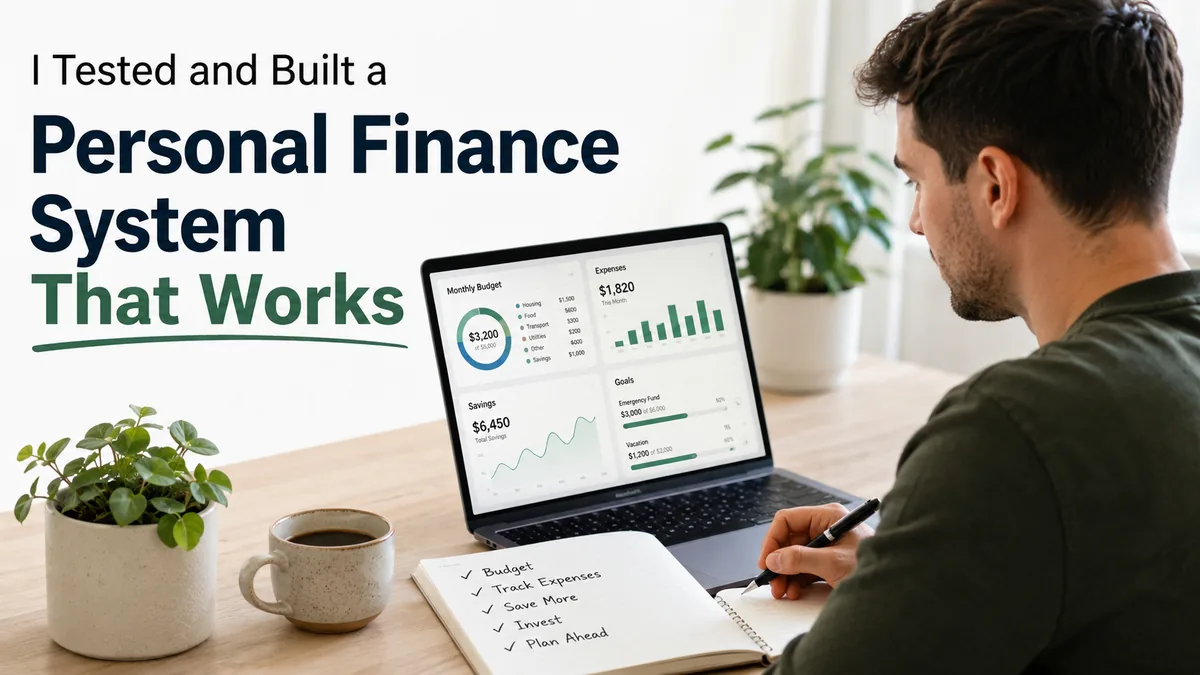
When I first tried to manage my money seriously, I did what most motivated people do.
I downloaded a budgeting app. Then, I made a beautiful spreadsheet. After that, I created strict spending limits for groceries, coffee, subscriptions, eating out, transportation, and every tiny category I could think of.
For about one week, I felt like a financial genius.
Then real life happened.
A bill arrived earlier than expected. A small annual subscription renewed. Groceries cost more than planned. In addition, I forgot to track a few expenses. Suddenly, the system that looked perfect on Sunday night felt annoying by Thursday afternoon.
That was the first thing I learned: many personal finance systems do not fail because people are lazy. Instead, they fail because the system is too complicated, too strict, or too disconnected from how people actually live.
Eventually, what worked for me was not a perfect spreadsheet. It was a simple, repeatable, flexible personal finance system that focused on cash flow, automation, emergency planning, spending awareness, debt strategy, and regular money reviews.
This article is for educational purposes only. It is not personalized financial, legal, tax, or investment advice. Everyone’s situation is different. Therefore, major financial decisions should be based on your income, expenses, debt, family needs, job stability, risk tolerance, and long-term goals.
Table of Contents
Why Most Personal Finance Systems Fail
Most personal finance systems fail because they are built for an ideal version of life.
The plan assumes every month is normal. However, real months are rarely normal.
One month has a car repair. Another month has a birthday gift. Then there is a medical bill, a school fee, a higher electricity bill, or a random “I forgot about this” subscription.
Because of this, strict budgets often collapse.
The Consumer Financial Protection Bureau explains that a budget is a plan for how to spend and save money. It also explains that learning how to make one is an important step toward reaching financial goals 1.
That matters because many people build budgets based on hope, not behavior.
For example, someone may decide to spend less on food. However, if they do not check how much they usually spend, the budget becomes a guess. Then, when the number fails, they feel guilty instead of informed.
In practice, a good system should help you adjust. It should not punish you for being human.
What I Learned From Testing Different Money Methods
After testing different systems, I noticed that every method has strengths and weaknesses.
Tracking every tiny expense gave me useful information. However, it also became exhausting. Meanwhile, ignoring spending completely felt easier in the moment, but it created anxiety later.
Budgeting apps helped with visibility. Still, they did not magically fix my habits. A spreadsheet helped me understand patterns, but it became useless when I stopped updating it.
The mistake I kept making was thinking motivation would carry the system.
It did not.
Motivation is great at the beginning. However, cash flow matters more. Habits matter more. Automation matters more. More importantly, a system that still works when you are busy, tired, distracted, or slightly unmotivated is much better than a perfect plan that requires constant effort.
From my experience, the best system is not always the most complicated one.
Ultimately, the best system is the one you can repeat.
The Foundation: Know Where Your Money Actually Goes
Before building a personal finance system, you need to understand your cash flow.
Cash flow simply means what comes in, what goes out, and what is left.
That includes:
- Income
- Fixed bills
- Variable spending
- Debt payments
- Savings
- Subscriptions
- Irregular expenses
- Personal spending
- Long-term goals
Consumer.gov offers a simple budget worksheet that helps people compare monthly income with monthly spending. Then, they can use that information to plan the next month 2.
A practical way to start is to review the last 30 to 90 days of spending.
You do not need to judge every transaction. Instead, sort your spending into broad categories. Look at bills, groceries, transportation, subscriptions, eating out, debt payments, and savings.
More importantly, look for patterns.
Are subscriptions quietly adding up? Are small convenience purchases becoming a large category? Are irregular expenses surprising you every month?
At first, this step may feel uncomfortable. However, it gives you clarity.
And clarity is better than guessing.
Step 1 — Build a Simple Monthly Money Map
A monthly money map is not the same as a strict budget.
A strict budget often says, “You must spend exactly this amount.” On the other hand, a money map says, “Here is where your money needs to go before the month gets chaotic.”
Your money map can include:
- Income
- Rent or mortgage
- Utilities
- Groceries
- Transportation
- Insurance
- Debt payments
- Savings
- Retirement or long-term saving
- Personal spending
- Irregular expenses
For example, instead of creating twenty tiny categories, you might create a few simple groups: bills, daily spending, savings, debt, and future expenses.
The goal is not perfection.
The goal is visibility.
Once you can see the month clearly, you can make better decisions before the money disappears into random spending.
Step 2 — Separate Money by Purpose
One checking account can make money feel confusing.
You may look at your balance and think you have more available than you really do. However, part of that money may already belong to rent, utilities, insurance, or a payment due next week.
Because of this, separating money by purpose can make the system much easier.
You can separate money into:
- Bills
- Daily spending
- Emergency fund
- Sinking funds
- Savings goals
- Debt payoff
- Long-term saving
This does not always require multiple bank accounts. Some people use separate accounts. Meanwhile, others use app categories, envelopes, spreadsheets, or simple notes.
The tool matters less than the purpose.
What finally worked for me was treating money as assigned before I spent it. When money had a job, I stopped pretending the full account balance was available.
As a result, spending decisions became less emotional.
Step 3 — Create a Starter Emergency Fund
An emergency fund is not an optional extra. It is part of the system.
The CFPB defines an emergency fund as a cash reserve set aside specifically for unplanned expenses or financial emergencies. These may include car repairs, home repairs, medical bills, or loss of income 3.
Without an emergency fund, every surprise becomes a budget crisis.
A starter emergency fund does not need to be perfect. It is simply the first cushion. The full amount depends on your expenses, job stability, dependents, health needs, and risk level.
For someone with unstable income, the target may need to be larger. On the other hand, someone with stable income and fewer responsibilities may start differently.
In practice, the emergency fund creates breathing room.
It does not make life predictable. However, it makes surprises less destructive.
Step 4 — Use Sinking Funds for Predictable Surprises
Sinking funds changed the way I looked at “unexpected” expenses.
Many expenses are not truly unexpected. They are just irregular.
For example:
- Car maintenance
- Annual subscriptions
- Holidays
- Gifts
- Medical costs
- Insurance premiums
- Home repairs
- School expenses
- Travel
- Pet care
A sinking fund is money set aside slowly for a future expense.
Instead of being shocked by a yearly bill, you divide it into monthly amounts. For example, if an annual expense is expected later, you can set aside a small amount each month instead of scrambling when it arrives.
As a result, budgeting feels calmer.
It also reduces the need to use credit cards for predictable costs.
Step 5 — Automate the Important Parts
Automation helps because it reduces decision fatigue.
The FDIC explains that automatic transfers into savings on a set schedule can help people save money before they spend it 4.
This is one of the most practical money habits I tested.
If I waited to save whatever was “left over,” the leftover amount was usually disappointing. However, when savings happened automatically, it became part of the system instead of a monthly negotiation.
You can automate:
- Bills
- Savings transfers
- Emergency fund contributions
- Retirement contributions
- Debt payments
- Sinking fund transfers
However, automation needs attention.
Do not automate payments if your balance is too unpredictable. Otherwise, overdrafts or failed payments can create more stress. In addition, review automated payments regularly so old subscriptions or unnecessary transfers do not keep running quietly.
Automation is not “set it forever.”
Instead, it is “set it, then review it.”
Step 6 — Choose a Debt Strategy That Fits Your Personality
Debt needs a plan.
At minimum, make required payments on time for all debts. After that, if you have extra money to pay down debt, you can choose a strategy.
The FTC recommends reviewing your debts, contacting creditors when needed, and creating a realistic payment plan you can afford 5.
Two common payoff methods are the debt avalanche and debt snowball.
The debt avalanche focuses extra payments on the highest-interest debt first. Mathematically, this can reduce interest costs over time.
Meanwhile, the debt snowball focuses extra payments on the smallest balance first. Psychologically, this can build motivation because you see progress faster.
Neither method is perfect for everyone.
If numbers motivate you, avalanche may feel better. If progress motivates you, snowball may help you stay consistent.
Ultimately, the best debt payoff strategy is the one you can actually follow without ignoring your other basic financial needs.
Step 7 — Make Long-Term Saving Part of the System
Long-term saving is easy to delay because it does not feel urgent.
However, ignoring it forever can create bigger problems later.
The SEC’s Investor.gov compound interest calculator explains how money can grow over time through the power of compounding 6. The key idea is simple: earnings can generate their own earnings over time.
That does not mean investing is guaranteed. It is not. Investments can lose value, and readers should understand risk before choosing where to put money.
Still, long-term saving should be part of the system when possible.
FINRA explains that retirement plans vary, but many offer tax advantages and different contribution rules depending on the plan type 7.
If an employer offers a retirement match, it may be worth understanding how it works. However, the right contribution level depends on your full financial situation, including debt, emergency savings, income stability, and short-term needs.
Start with education.
Then build the habit carefully.
Step 8 — Create a Weekly Money Check-In
A weekly money check-in is where the system becomes real.
Waiting until the end of the month is often too late. By then, the money is already spent, the mistakes are already made, and the review feels like a punishment.
A weekly check-in can take 10 to 20 minutes.
Review:
- Current account balances
- Upcoming bills
- Spending categories
- Debt payments
- Savings progress
- Unusual transactions
- Subscriptions
- Any expected irregular expenses
This check-in should not feel like a court trial.
It is not about guilt. Instead, it is about staying aware before small issues become bigger problems.
In practice, this was one of the most useful habits because it kept the system alive.
Step 9 — Create a Monthly Money Review
The monthly review is different from the weekly check-in.
The weekly check-in helps you stay on track. Meanwhile, the monthly review helps you improve the system.
At the end of each month, ask:
- What worked?
- What failed?
- Which category was unrealistic?
- What expense surprised me?
- What subscription should I cancel?
- Did I make progress on savings?
- Did debt go down?
- What is coming next month?
- What needs to change?
This is where flexibility matters.
A personal finance system should evolve. If groceries are always higher than planned, adjust the category. If a sinking fund is too small, increase it. If tracking is too complicated, simplify it.
Quitting after one imperfect month is not necessary.
Adjusting is the point.
What Finally Made the System Work
What finally worked for me was simplicity.
Not extreme discipline. Not a perfect spreadsheet. Not tracking every penny forever.
In practice, the system became easier when I focused on:
- Clear categories
- Separated money
- Automatic savings
- Emergency planning
- Sinking funds
- Realistic spending
- Weekly check-ins
- Monthly reviews
- Less guilt
- More clarity
The biggest shift was emotional.
Instead of using money management as a way to shame myself, I started using it as a way to reduce chaos.
Because of this, the system felt useful instead of stressful.
The Personal Finance System I Would Recommend
Here is the framework I would recommend for building a personal finance system that actually works:
- Review the last 90 days of spending.
- Build a monthly money map.
- Separate money by purpose.
- Create a starter emergency fund.
- Set up sinking funds.
- Automate bills and savings carefully.
- Choose a debt payoff strategy.
- Start or maintain long-term saving.
- Do a weekly money check-in.
- Do a monthly money review.
- Adjust the system instead of quitting.
This system is simple on purpose.
It gives your money structure without making your life feel like a finance exam.
Common Mistakes to Avoid
The biggest mistake is making the system too complicated.
If your system requires constant maintenance, you may eventually avoid it.
Other common mistakes include:
- Tracking everything but changing nothing
- Ignoring irregular expenses
- Having no emergency fund
- Depending only on motivation
- Cutting all fun spending
- Copying someone else’s budget exactly
- Forgetting to review subscriptions
- Ignoring debt interest rates
- Delaying long-term saving forever
- Quitting after one imperfect month
Cutting all fun spending is especially risky.
A budget with no room for real life often creates burnout. Meanwhile, a realistic plan gives spending boundaries without making life feel miserable.
A Practical Personal Finance System Checklist
Use this checklist to build or review your system.
Cash Flow
- Do I know my monthly income?
- Do I know my fixed expenses?
- Do I know my variable expenses?
- Have I reviewed the last 30 to 90 days?
Planning
- Do I have a monthly money map?
- Are bills separated from daily spending?
- Do I have categories that match real life?
Protection
- Do I have a starter emergency fund?
- Am I building toward a stronger cushion?
- Do I have sinking funds for irregular expenses?
Debt
- Am I making minimum payments on time?
- Do I know my balances and interest rates?
- Have I chosen avalanche, snowball, or another realistic plan?
Long-Term Goals
- Am I saving for future goals?
- Do I understand my retirement options?
- Am I learning before making investment decisions?
Habits
- Are important payments automated safely?
- Do I check money weekly?
- Do I review the system monthly?
- Do I know my spending triggers?
- Have I reviewed subscriptions recently?
Goals
- Are my financial goals specific?
- Are they realistic for my income?
- Do I adjust when life changes?
Final Takeaway
A personal finance system does not need to be perfect to work.
It needs to be clear, repeatable, flexible, and honest about real life.
The best system is not the one that looks impressive in a spreadsheet. It is the one that helps you make better money decisions consistently.
For me, the system started working when I stopped trying to control every tiny detail. Instead, I started building around real behavior: cash flow, emergency planning, automation, sinking funds, debt strategy, and regular reviews.
Ultimately, the goal is not to become perfect with money.
The goal is to reduce confusion, make progress, and build a system you can actually keep using.
FAQ
What is a personal finance system?
A personal finance system is a repeatable way to manage income, expenses, savings, debt, goals, and financial reviews.
How do I build a personal finance system?
Start by reviewing your spending, creating a monthly money map, separating money by purpose, building an emergency fund, automating key habits, and reviewing regularly.
Is budgeting enough to manage money?
Budgeting helps, but it is not enough by itself. A complete system also includes emergency savings, debt planning, automation, sinking funds, and regular reviews.
What is the best budgeting method?
There is no single best method. Zero-based budgeting works for some people, while 50/30/20 budgeting works better for others. The best method is the one you can follow consistently.
How much should I keep in an emergency fund?
The right amount depends on your expenses, income stability, dependents, debt, and risk level. A starter fund can help first, then you can build a larger cushion over time.
What are sinking funds?
Sinking funds are savings categories for irregular but predictable expenses, such as car repairs, annual subscriptions, gifts, holidays, or insurance premiums.
Should I pay debt or save first?
It depends on your situation. Many people benefit from making minimum debt payments, building a small emergency cushion, and then focusing extra money on high-interest debt.
How often should I review my finances?
A weekly check-in helps you stay aware, while a monthly review helps you adjust the system and plan for the next month.
Why do most budgets fail?
Most budgets fail because they are too strict, too complicated, unrealistic, or not connected to actual spending behavior.